


You pull your credit score, and your heart sinks. It’s lower than you expected. It could be in the 500s. Maybe the low 600s. And now you’re convinced you’ll never qualify for a mortgage.
You should know that you don’t need perfect credit to buy a home. In fact, you might qualify for a mortgage right now, depending on the loan type.
And if you’re not quite there yet? You can make real progress in as little as 90 days with the right strategies.
Let me walk you through the credit score minimums for each loan type and the factors that affect your score.
Minimum Credit Scores by Loan Type
First, let’s clear up what you actually need. Here’s what most lenders require for each mortgage option:
| Loan Type | Minimum Credit Score | Down Payment Requirement | Notes |
|---|---|---|---|
| Conventional Loan | 620 | 3% minimum | Best rates start at 740+ |
| FHA Loan | 580 | 3.5% | Scores 500-579 require 10% down |
| VA Loan | No official minimum | 0% | Most lenders prefer 620+ |
| USDA Loan | 640 | 0% | Some lenders accept 620+ |
Important context: These represent minimum qualifying scores, not ideal targets. Higher credit scores significantly improve both your approval odds and the interest rates you’ll be offered.
For the most competitive interest rates on conventional loans, target a credit score of 740 or above. However, FHA loans have no additional fees for lower scores, so you can access competitive rates with a score as low as 600.
How Your Credit Score Affects Your Mortgage
Your credit score directly affects two critical things:
1. Whether you get approved at all
2. What interest rate will you pay
Even minor credit score differences can mean thousands of dollars in savings over your loan’s lifetime.
Example: Let’s say you’re buying a $300,000 home with 3% down.
- With a 7% interest rate (lower credit score): Monthly payment of ~$2,200
- With a 6.875% interest rate (higher credit score): Monthly payment of ~$2,176
While that’s just $24 per month, you’d save over $8,000 across a 30-year mortgage with the lower rate.
The savings amplify with larger score gaps. A person with a 630 credit score might pay 1-2% more in interest than someone with a 760 score—potentially costing tens of thousands of dollars over the loan’s lifetime.
What Makes Up Your Credit Score?
Your FICO® Score, used by 90% of top lenders, is calculated based on five key factors that reflect your credit behavior. Understanding these factors helps you prioritize where to focus your improvement efforts.
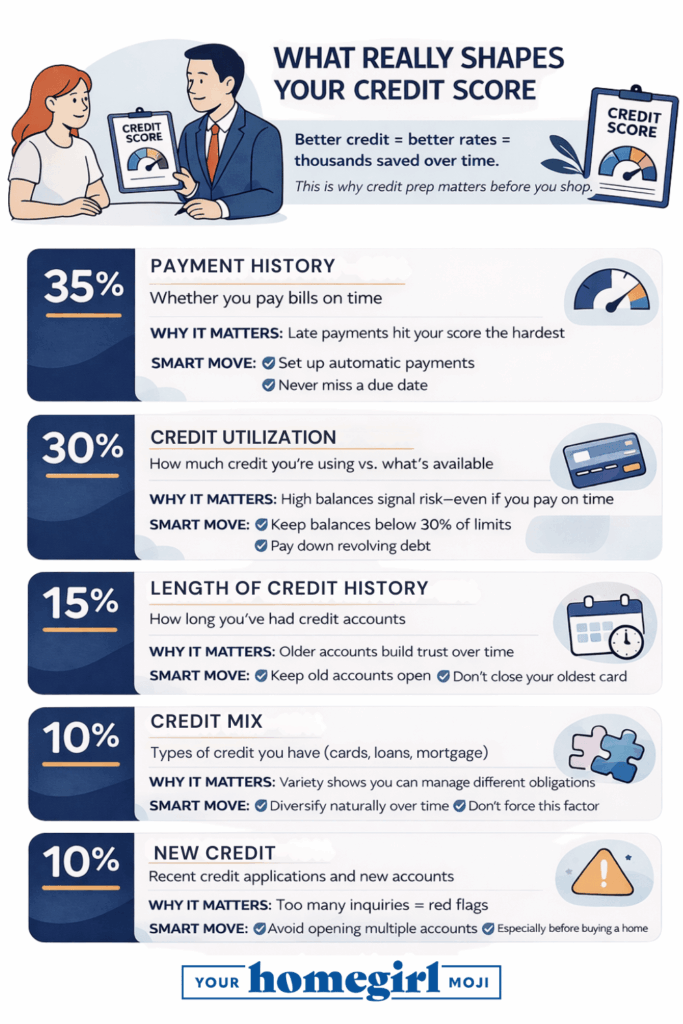
The most important factor in your FICO® Score is your payment history. Consistently paying on time each month is the single most crucial step you can take to build and maintain strong credit.
What NOT to Do While Improving Your Credit
Avoid these common mistakes that can sabotage your progress:
❌ Making large purchases on credit
Wait until after you close on your home to finance furniture or buy a new car (The Mortgage Reports, 2024).
❌ Closing credit cards after paying them off
Keep accounts open to maintain your available credit and credit history length.
❌ Co-signing loans for others
This adds debt to your credit report and can lower your score.
❌ Missing payments on anything
Even one 30-day late payment can drop your score by 100+ points if you previously had a perfect payment history.
❌ Maxing out cards before paying them off
Even if you pay in full each month, high balances reported to credit bureaus hurt your score.
❌ Applying for retail store credit cards
That 15% discount isn’t worth the hard inquiry and the potential increase in utilization.
Long-Term Credit Maintenance After You Buy
Once you’ve improved your score and secured your mortgage, maintain your progress:
✓ Continue paying all bills on time, every time
✓ Keep credit card balances below 30% of limits (ideally below 10%)
✓ Maintain a mix of credit types (mortgage, car loan, credit cards)
✓ Avoid opening multiple new accounts within short periods
✓ Check your credit reports annually for errors
✓ Use credit regularly but responsibly (inactive accounts may be closed by issuers)
The Bottom Line
You don’t need perfect credit to buy a home, but improving your score, even by 20-40 points, can save you thousands of dollars over the life of your loan.
The key to improvement is making smart decisions, paying your bills on time month after month, reducing your debt, and managing your credit usage as you go.
Start with the low-hanging fruit: dispute errors, pay down high balances, and set up autopay for everything. You can increase your credit score within the first 60 to 90 days with consistent effort.
Your credit score isn’t a permanent reflection of who you are; it’s a snapshot of your recent credit behavior. And that means you have the power to change it.
Your Action Plan
Don’t wait to check your credit. Pull your free credit reports this week and identify where you stand and what needs attention.
Download “Unlock Your Dream Home: The 90-Day Credit Strategy That Gets You Mortgage-Ready” to get a day-by-day action plan, a credit report error checklist, a debt paydown calculator, and a worksheet to track your score progress over the next three months. This tracker will keep you accountable and show you exactly what to do each week to maximize your score improvement.


